|
As we come out of the Thanksgiving season, I’ve been thinking a lot about gratitude — how powerful it is, how it shapes my perspective, and how much I depend on God’s goodness every single day. Thanksgiving gives me a moment to pause and remember that every good gift comes straight from Him. As I reflect, here are seven blessings I’m especially grateful for this year.
First, I’m thankful for God’s grace. Through Christ, God rescued me, forgave me, and made me His own. Romans 6:23 reminds me that I deserve death because of my sin, yet God freely gives eternal life through Jesus Christ. His grace strengthens me daily and gives me hope for tomorrow. I am deeply undeserving — but overwhelmingly grateful! Second, I’m thankful for my wife. She is my encourager, partner, and best friend. I definitely married way out of my league, and anyone who knows her would wholeheartedly agree! Her love, joy, and faithfulness are daily pictures of God’s kindness to me. Third, I’m thankful for my kids. They bring joy, laughter, and purpose into every day. Parenting three boys is more fun — and more sanctifying — than I ever imagined. Just this weekend, as we decorated the Christmas tree, I pulled out an old ornament from when I was a kid. It had “1989” written on the back. I told my boys, “Wow, this is from when I was four years old!” My six-year-old then asked, “Daddy… was that before or after the Titanic sank?” I laughed so hard. Kids keep me humble, remind me of childlike faith, and teach me that God often grows us in the process of raising them. Fourth, I’m thankful for my family. For the roots, the legacy, and the love that shaped me. My parents especially have been a steady picture of faithfulness and Christlike love. I’m grateful for the foundation God has given me through them. Fifth, I’m thankful for my church. A community pursuing Christ together and seeking to live “life by the Book.” It's such a joy to serve and worship with my fellow sheep! Following Jesus is not a long-ranger undertaking, and I’m thankful for a church family that encourages and strengthens my walk with Him. Sixth, I’m thankful for my colleagues. The leaders and teammates I get to serve alongside in Christian higher education — people who sharpen, challenge, and encourage me. I’m grateful to work with friends who love students, love Scripture, and love the Lord. Seventh, I’m thankful for my exercise buddies. These friends show up — even on cold mornings — pushing one another toward discipline, consistency, and growth. They remind me that physical stewardship matters and that community makes hard things more joyful. And they have pretty good banter which makes things exciting. Gratitude softens my heart and strengthens my faith. God has been faithful, He is faithful, and He will continue to be faithful. Praise His name! May we live with grateful hearts as we take steps to thrive for His glory.
0 Comments
College life brings an exciting mix of independence, responsibility, change and growth. But it also changes the dynamics of our relationships with family — sometimes in ways we are not expecting. Many feel the tension of wanting to honor their parents, care for siblings, and still establish healthy rhythms of their own. And if I’m honest reflecting on my experience, learning how to communicate and set boundaries biblically at times felt confusing and at times frustrating.
Ephesians 6:2–3 reminds us, “Honor your father and mother.” That doesn’t expire when we leave home. And Romans 12:18 calls us to “live peaceably with all” as far as it depends on us. So even as we mature into adulthood, our posture toward family should be rooted in love, honor, respect, and peace. But that does not mean we never set limits. In fact, healthy boundaries help us protect the relationship, not distance ourselves from it. Boundaries are simply clear, loving statements of what we can and cannot do — especially as our responsibilities grow. If this is new for us, Boundaries by Henry Cloud and John Townsend is an incredibly helpful Christian resource. When I graduated from college and moved overseas to another continent, I would travel all over Asia, sometimes taking multi-day trips to the Philippines or Singapore or Thailand or any number of countries. It was amazing. I love traveling internationally. Then I moved back to the States lived with my parents. At times I became frustrated when they asked where I was going when I left the house for a couple of hours. However, my heart posture needed to grow in gratitude that I had parents that cared enough about me to be concerned about my well-being. What a gift! I learned one of the best things we can do is to communicate proactively, not reactively. Most conflict with family doesn’t come from bad intentions — it comes from unspoken and unmet assumptions. We need to set boundaries with clarity and humility. A boundary is simply saying, ‘Here’s what I can realistically do, and here’s what I can’t.’ Clarity is kindness. And above all, keep love at the center. Colossians 3:14 says, ‘And above all these put on love, which binds everything together in perfect harmony.’ Love your parents. Respect them. Be patient with them as they adjust to your growing independence. In summary, boundaries without love become barriers. Love without boundaries leads to burnout. But genuine, biblical love with clear and respectful boundaries is foundational for flourishing relationships. May we grow with grace, speak with kindness, and honor Christ in the way we love our families. Many college students often consider the wisdom of dating, and may be asking: How do I balance time with God, school, friendships, and the desire to date?
It’s a real question—and the fact some are asking shows maturity. It's even to rush into dating without ever stepping back to consider God’s design. Before we try to balance everything, we need to remember the purpose of dating in the first place. The purpose of dating is to discover God’s will for marriage. And marriage is an incredible gift—a picture of the gospel, a partnership marked by grace and joy. Dating isn’t recreational; it’s directional. That’s why Scripture pushes us toward the deeper question: Who are we becoming? Jesus grew “in wisdom and in stature and in favor with God and man” (Luke 2:52, ESV). That’s the model for our development—intellectual, physical, spiritual, and relational growth. So instead of fixating on finding the right person, we’re invited to focus on becoming someone who honors Christ in every part of life. This shapes how we pursue relationships and how we discern God’s timing. For the men especially, this includes stewarding our whole selves—heart, mind, and body. Getting in shape isn’t about ego; it’s about responsibility. As I often remind myself as a married guy, “If love for my fiancée motivated me to get in shape for my wedding, then love for her now as my wife must motivate me to stay in shape for my marriage.” It’s an honor to provide and protect for my wife and kids - but it is very hard work. As we grow spiritually, academically, physically, and relationally, dating finds its proper place. It becomes a blessing—not a distraction—when our priorities are aligned. This week, I encourage you to ask someone who knows you well to identify one area where you can grow. Listen, learn, and trust God to shape you into the person He wants you to be. Marriage is worth the wait—and God’s timing is always best. Check out this Steps To Thrive Podcast Episode to learn more. One of the best questions I’ve received recently came from a student who asked, “I’m trying to grow in the area of leadership. Do you have any books or things you would recommend to help me grow?”
This is a fantastic question! It demonstrates a teachable heart and a willingness to do the work to grow. Leaders never stop learning. Proverbs 1:5 says, “Let the wise hear and increase in learning, and the one who understands obtain guidance.” Growth doesn’t happen by accident—it’s the result of consistent, intentional learning. As the saying goes, “Readers are leaders, and leaders are readers.” Reading is one of the simplest and most powerful ways to grow as a leader. It allows us to learn from the wisdom of others and stay grounded in truth. As Greg McKeown wrote in Essentialism, “A book is surely among the best investments of any on earth. For a few dollars, you gain access to what the smartest people on earth have already figured out.” I encourage my own children to read as much as they can (which is still a work in progress!), but it brings a genuine smile to my face when I see them reading – especially on their own volition. Here are a few books that have shaped my leadership and walk with Christ: · Instruments in the Redeemer’s Hands — Paul Tripp · The Disciplines of Grace — Jerry Bridges · What’s Best Next — Matt Perman · The 7 Habits of Highly Effective People — Stephen Covey · The Conviction to Lead — Albert Mohler · The Marks of a Spiritual Leader — John Piper You can find a longer list of books I recommend at stepstothrive.com/books. If you want to grow as a leader, start by growing as a reader. Begin with a simple goal: read just two pages a day. Over time, those pages will shape your mind, strengthen your faith, and help you take steps to thrive for God’s glory. How important is it to set and balance right priorities? How do we even know how to start? A listener recently asked, “How do I balance school, friends, exercise, and time with God when there’s only so much time in a day?”
These are great questions — and we all wrestle with how to use the time we have. Setting and pursuing right priorities is a habit that we work on for a lifetime. God gives each of us 24 hours, and learning to use them wisely starts with knowing our priorities. Proverbs 16:3 reminds us, “Commit your work to the Lord, and your plans will be established.” The most important part of your day is time with God. I encourage you to intentionally spend time in God’s Word before you even unlock your phone. Really – try it! Perhaps you can spend a few quiet minutes reading a proverb or a short passage in the New Testament. Kevin DeYoung writes in his book Crazy Busy, “We won’t say no to more craziness until we can say yes to more Jesus.” That’s a great reminder. Other friendships matter too. If you’re a student, studying is part of your calling right now — preparation for future ministry and influence. And friendships? They remind us that we’re human beings made in God’s image. God created us for relationship with Him and with one another. Another topic that Caleb mentions is exercise. This is a personal passion of mind, and I encourage you to make healthy choices in what you eat and how you exercise your body. Exercise builds discipline and strengthens your capacity to serve others well. Here’s a simple challenge: write your priorities into your calendar. Schedule time with God, study time, exercise, and even lunch with a friend. Unscheduled priorities become lost priorities. Pursue the habit of structuring your time around what truly matters — and take daily steps to thrive for God’s glory. Why Another Podcast?
That's actually a really great question. While doing research about podcasting, I discovered there are over 4 million podcasts. However, only 10% are still active, and half of podcasts that begin don't make it past 3 episodes and only 8% make it past 20 episodes. So why one more?
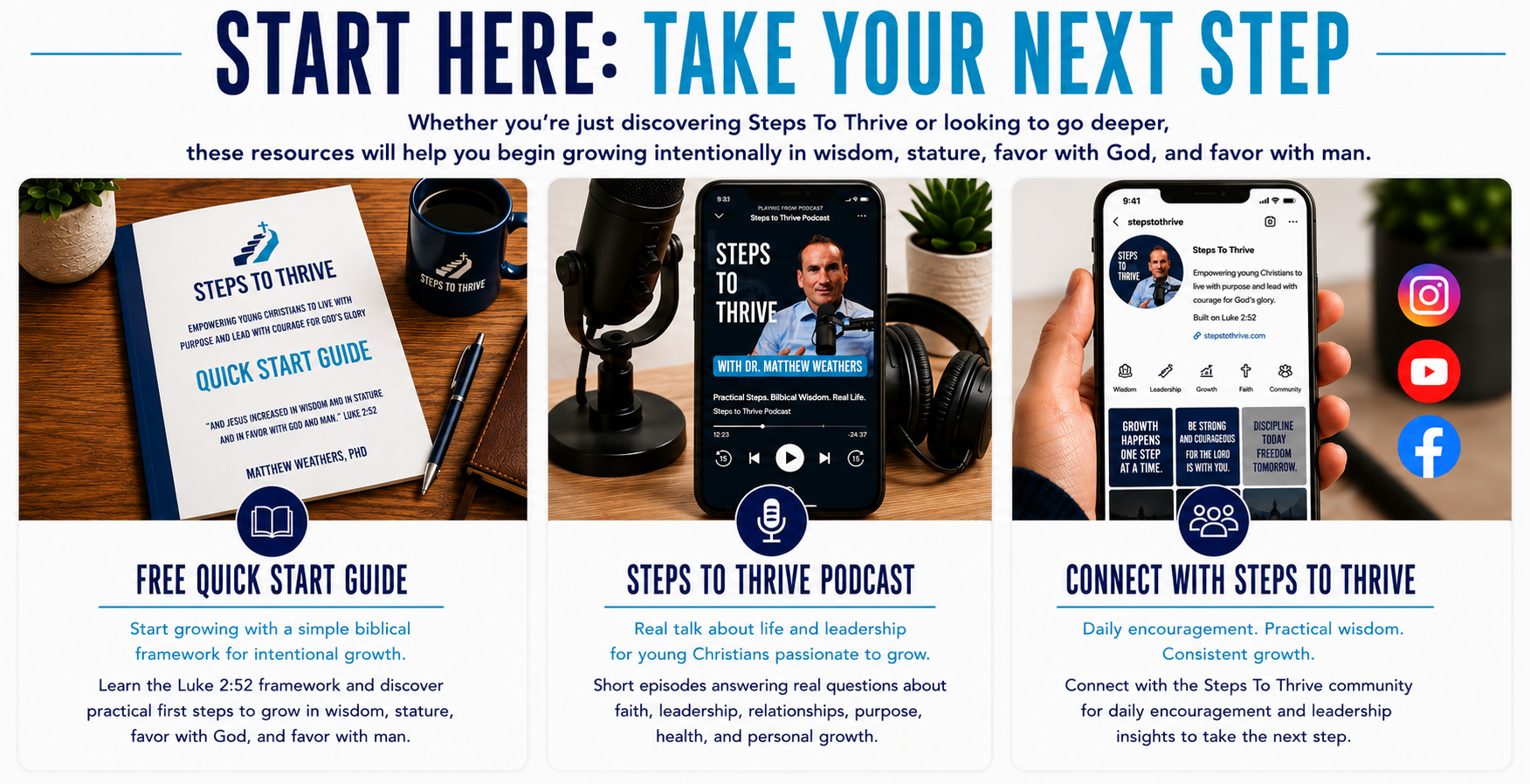
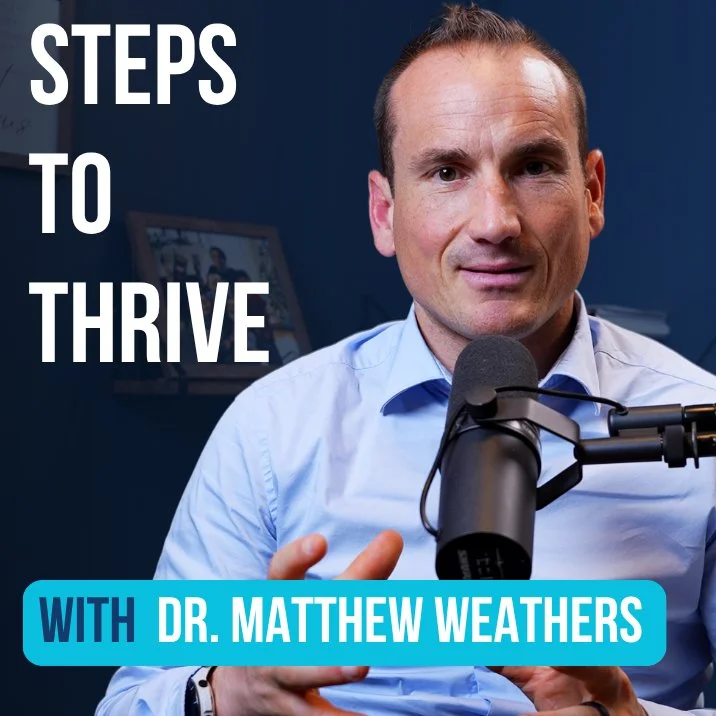
What's the format? My goal is for each episode to be just five minutes long — short enough to fit your day, but packed with "real talk about life and leadership for young Christians passionate to grow." We’ll explore topics like relationships, purpose, discipline, integrity, and influence — all through the lens of Scripture. I have received hundreds of questions from teens around the country while speaking at various teen conferences, and I hope to answer some of those questions. I also hope to answer questions that come in through the Podcast tab on the website or through email ([email protected]). But this isn’t just about me giving answers (I don't have all the answers!). I want to learn alongside you. I’m still growing, still learning, and still being shaped by God’s Word. My hope is that as we walk together, we’ll take practical steps toward wisdom, faithfulness, and impact — one week, one truth, and one decision at a time. Let’s keep taking steps to thrive — for God’s glory and the good of others. Let's go! "Great commandment obedience fuels great commission living." I think about this often. Jesus summarized the Christian life for us in two commands that are at difference places in Scripture but inseparable in how we pursue their fulfillment.
“You shall love the Lord your God with all your heart and with all your soul and with all your mind… and you shall love your neighbor as yourself.” (Matthew 22:37–39, ESV) Too often, we try to fulfill the Great Commission — to “go and make disciples of all nations” (Matthew 28:19, ESV) — without first being rooted in the Great Commandment. But trying to make disciples and fulfill the great comission without love for God and others becomes impossible. True obedience to Christ flows from affection for Him. When we are growing in love for God and others, we begin to see people the way He does. Our hearts become burdened for the lost, compassionate toward the hurting, and eager to serve. If we want to live in a way that impacts eternity, may we focus first on deepening our love for the One who sends us. May we sit at His feet and be shaped by His Word. Loving God well leads to living sent — not out of guilt or duty, but out of overflowing joy in the One who first loved us. Yes, Great Commandment obedience fuels Great Commission living. The corporate world often defines leadership by title, position, or status, but true biblical leadership is defined by service. As author Simon Sinek writes, "Leadership is not about being in charge. It's about taking care of those in your charge." This is one of my favorite quotes on leadership. It shifts the focus away from personal gain and onto the responsibility of serving others. For young Christians, this means using your influence—whether on your campus, your sports team, or your part-time job—to champion the well-being and growth of the people around you. You lead by taking initiative, setting an example of integrity, and looking out for the person who needs encouragement.
If you are currently in a position of authority, or even if you simply want to grow your personal influence, remember that your power comes from how well you serve. You do not have to have a position to make a difference. True impact is measured not by the number of people who follow you, but by the number of people you empower. Choosing service over status is at the heart of servant leadership, reflecting Jesus' example, who came "not to be served but to serve." By consistently seeking to take care of those in your charge, you move from merely managing a role to genuinely leading people and impacting them for God's glory. Stay awesome, and stay on the narrow path taking steps to thrive for God's glory! Guest Post by my brother-in-law, Nick Allen
The last few months have been tough. Neurological symptoms and fatigue have held me back, and many of the goals I set for this winter – skiing, ski touring, climbing peaks – simply didn’t happen. I had envisioned spending many bluebird days in the mountains this winter, enjoying the pleasure of skiing fresh powder on backcountry slopes, and the quiet satisfaction of standing next to a summit. Instead, I have found myself retreating from the peaks and, more often, sitting at home, managing symptoms as I watched other people get outside. During setbacks, I often feel a deep sense of loss. I’ve worked hard toward those goals, and letting them go feels like something important had slipped away – moments of joy that can never be recovered. But that’s when I remind myself: Hold tight to values; hold light to goals. I’ve realized that goals are like peaks – a desired outcome that you work towards. Values are the compass – the guiding principles that map out the path and our decisions along the way. Values don’t change when plans fall apart or the body doesn’t cooperate. Values stay with us, quietly reminding us of what matters most. When life gets hard, it’s tempting to focus on the goals we can’t or didn’t do. Values invite us to focus on the next step, asking the question: “How can I still live the kind of life I care about, even here, even now?” Living out my values, adventure is exploring a new street or road during my morning walks. Curiosity is learning something new, or noticing the play of light across the footpath as I walk. Spirituality is about enjoying moments of stillness and connecting to God who is infinitely bigger than me – not in dramatic mountaintop experiences, but in a small quiet moment close to home. These moments don’t replace the big adventures, but they keep me connected to the thread that runs through them. Sometimes, we are asked to let go of what we planned so we can hold more tightly onto what matters. That’s not giving up — it’s choosing to keep showing up for the things that make life meaningful, even when the our circumstances are limited. To learn more about Nick, check out his book To The Summit and visit the Mastering Mountains website. In a world pulling us in countless directions, the Christian man is called to a higher standard of leadership—starting with leading himself. Self-leadership, rooted in biblical principles, isn't about rigid control but about aligning our actions and desires with God’s will and cultivating inner strength and integrity that flows outward into our families, workplaces, and communities. Here are five essential pillars for building a foundation of strong self-leadership.
1. Prioritize Your Relationship with God. This is the bedrock of all effective self-leadership. Just as a plant withers without water, our ability to lead ourselves falters without consistent connection to our Heavenly Father. This means making time for prayer and studying His Word, not as a duty, but as a vital lifeline. When our relationship with God is our top priority, everything else falls into its proper place. 2. Proper Motivation: Love for God and Others. Our actions as self-leaders should be driven by a deep and abiding love for God and a genuine care for others. This biblical motivation transcends selfish ambition or the pursuit of worldly accolades. When our choices are fueled by love for God and others, they become less about personal gain and more about serving God and blessing those around us. 3. Learn to Say No. In a culture that often equates busyness with importance, the ability to say "no" is crucial. This isn't about being unhelpful, but about discerning our priorities and protecting the time and energy needed for what truly matters: our relationship with God, our families, and our specific responsibilities. Saying "no" to good things allows us to say "yes" to the best things. It may feel hard at first but gets easier with practice. 4. Embrace Delayed Gratification. Our instant-gratification culture clashes with godly living. Self-leadership requires the discipline to choose long-term spiritual growth over immediate pleasures. This might mean resisting impulsive spending or sacrificing leisure for important responsibilities, knowing that the ultimate reward is found in Christ. Cultivating this discipline strengthens our resolve and aligns our choices with our values. 5. Work Hard When Nobody Is Watching. Integrity is the cornerstone of true self-leadership, and it is most evident in our commitment to hard work even when we're not being observed. Our diligence reflects our character and our understanding of work as an act of worship. When we consistently strive for excellence in private, it builds a foundation of trustworthiness and shows a heart that truly seeks to honor God in all things. By cultivating these five pillars, we can grow in self-leadership, becoming more effective in their homes, churches, and communities, and ultimately bringing greater glory to God. May God give us strength for this task! |
RSS Feed